


Discover Alloyman’s professional 16-line 4D laser levels featuring high-visibility green beams designed for both indoor and outdoor applications. With full 360° horizontal and vertical coverage, these self-leveling laser tools provide accurate alignment for construction, installation, and renovation tasks.
Engineered for precision and reliability, Alloyman laser levels help contractors, installers, and DIY users achieve straight lines, perfect leveling, and consistent results on every project.


The laser level tripod features a 360°×4-line laser beam, the laser grade is Class II, and the vertical and horizontal accuracy reaches±1mm/5m. The high-visibility laser line is clearly visible in both dim and bright environments, ensuring accurate measurements and reducing errors - perfect for professional and DIY projects. 【Extended Working Range】With a maximum working range diameter of up to 150ft, this laser level tripod allows for remote control operation, providing convenience and flexibility in various project environments. 【Self-leveling Mode & Manual Mode】Long press the mode switch button to choose between auto-leveling mode and manual mode. When the pendulum is unlocked, the laser level will automatically level within 3°. If the surface is tilted more than 3°, it will continue to flash and beep to remind you that it is not level. While the manual mode allows projection on tilted surfaces, enhancing versatility. 【2-in-1 Accessories】The kit includes a 37.5in tripod and a magnetic mount, allowing users to easily adjust and position the laser level as needed for various applications, enhancing usability and efficiency. 【Long-lasting Power Supply】Equipped with 2*4.0V lithium batteries, the laser level tripod provides up to 12 hours of continuous operation, giving you the reliability and stamina to complete even the most demanding tasks without interruptions. 【Durable and Long-lasting】Built to withstand challenging conditions with an IP54 waterproof and dustproof rating, this laser level operates in temperatures from -20°C to +50°C.
$69.00 - $129.99


Experience superior precision with a leveling accuracy of ±2mm within a 10-meter range. The Ⅱ-grade laser output, with power less than or equal to 1mW, covers a working range of up to 98ft, making it ideal for any professional or DIY project.
$159.99 $99.99


Professional 4×360° green laser level engineered for contractors, builders, and precision-focused DIYers who demand accuracy across large-scale layout and leveling projects. Precision Performance 4×360° Full-Plane Coverage – Four independent 360° laser lines create complete horizontal and vertical reference planes, eliminating blind spots and reducing setup time ±0.2mm/10m Accuracy – Class II laser delivers professional-grade precision for framing, tiling, cabinetry, electrical, and HVAC installations High-Visibility Green Beam – Up to 4× brighter than red lasers for superior visibility in bright ambient light and outdoor conditions Versatile Operation Self-Leveling Technology – Auto-levels within 3° tilt range with audible out-of-level warning; manual mode available for angled applications Outdoor Pulse Mode – Extends working range up to 98 feet when paired with a laser receiver (sold separately) for exterior layout work 360° Rotating Base – Aluminum alloy emission window rotates fully for flexible line projection without repositioning the unit Remote Control Included – Operate laser functions from a distance for one-person efficiency on large job sites Built for the Job Site Dual 4.0V Lithium Batteries – Up to 12 hours of continuous runtime for all-day operation without recharging Adjustable Tripod (17" – 37.5") – Three height settings provide optimal working elevation for walls, ceilings, and floor layouts Multiple Mounting Options – Includes rotating magnetic bracket, low tripod, and elevating platform for versatile positioning on metal surfaces, uneven terrain, or elevated work Complete Kit Includes 1× Alloyman 4×360° green laser level 1× Height-adjustable tripod (17" / 24" / 37.5") 1× Rotating magnetic bracket 1× Low tripod base 1× Elevating platform 2× 4.0V lithium-ion batteries 1× Remote control 1× Protective carrying bag 1× User manual Ideal for framing, drywall, tile installation, cabinet mounting, electrical conduit layout, deck construction, and interior/exterior leveling applications.
$89.99


$99.99 $69.99


Professional-grade precision meets versatile mounting—tackle floor-to-ceiling projects with confidence. The Alloyman 4×360° Green Laser Level delivers pinpoint accuracy for framing, tiling, electrical work, and layout tasks. With a complete tripod and 12ft telescoping pole system, you're equipped to handle any job site challenge from foundation to finish. Key Features 4×360° Full-Room Coverage – Class II laser with ±1mm/5m accuracy projects ultra-bright green lines visible in dim and bright conditions for error-free alignment on walls, floors, and ceilings. 12ft Telescoping Pole Included – Four adjustable rods extend from floor to ceiling (up to 3.6m), with dual inch/cm markings for fast, repeatable height positioning without ladders. Outdoor Pulse Mode Ready – Pair with a laser receiver (sold separately) to extend range up to 150ft outdoors, plus remote control operation for one-person efficiency. Smart Self-Leveling – Auto-levels within 3° and alerts with flash/beep if tilted beyond range; switch to manual mode for angled projections on stairs or slopes. Universal Mounting Bracket – 1/4"-20 and 5/8"-11 threads fit most line and rotary lasers, with fine-tuning knob for 3.14" (8cm) micro-adjustments. All-Day Runtime – Dual 4.0V lithium batteries deliver up to 12 hours of continuous use; Type-C charging keeps downtime minimal. Complete Kit Includes 1× 4×360° Green Laser Level 1× Professional Tripod 4× Telescopic Rods + 1× Tail Rod (12ft total) 2× Rechargeable Li-ion Batteries 1× Remote Control 1× 360° Magnetic Swivel Stand 1× Type-C Charger 1× Target Plate 12-Month Warranty Built for pros, priced for everyone. Whether you're installing cabinets, running conduit, or laying tile, the Alloyman laser level system gives you the accuracy and flexibility to work faster and finish cleaner.
$159.99 $129.99


With 2 horizontal 360° and 2 vertical 360° designs. High Visibility Green line laser. 2Pcs 3000mah Battery. With newly upgraded diode and chip technology, the precision of 33 inches is ±1/9 inches. IP54 water and dust resistance. Strong magnetic bracket.
$159.99 $59.99
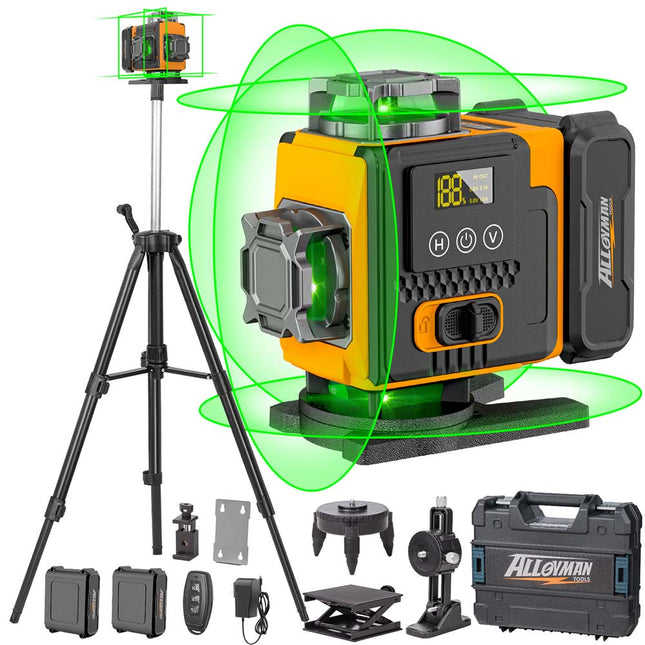

The ALLOYMAN 16-line laser level features 2 horizontal 360°and 2 vertical 360°lasers to easily cover the entire room—floor, walls, and ceiling. The horizontal and vertical lines intersect at 90°angles, helping you quickly visualize and complete square layouts.
$159.99 $79.99
A 4D laser level projects four full 360° planes—two horizontal and two vertical—creating a complete reference grid from a single setup. This allows you to align multiple surfaces at once without constantly repositioning the tool.
It’s especially useful for large or complex interior projects such as ceiling installation, wall framing, tile layout, or cabinet alignment across different walls. If your work requires accurate leveling in multiple directions simultaneously, a 4D laser level can significantly improve efficiency compared to standard 2D or 3D models.
A 4D laser level projects multiple full 360° laser lines across both horizontal and vertical planes, creating a complete reference grid around a room. Compared to a standard 360° laser level, a 4D model typically adds extra vertical or horizontal lines, making it more suitable for complex layouts like tile installation, cabinetry, or full-room alignment.
Yes, a 360° laser level is ideal for most home improvement tasks such as hanging shelves, installing cabinets, or aligning tiles. It provides continuous level lines around a space, reducing the need to reposition the tool frequently.
A laser level with a tripod offers greater stability and adjustable height, making it easier to position the laser accurately. It is especially useful for uneven surfaces, large rooms, or outdoor work where precise alignment is required.
Green laser levels are typically more visible than red laser levels because the human eye is up to 3–4 times more sensitive to green wavelengths (around 520–550 nm). This means that at the same power output, a green beam appears significantly brighter than a red one.
A tripod isn't always required, but it dramatically improves accuracy and workflow efficiency. Without one, you're limited to placing the laser on a flat surface, which restricts both height adjustment and positioning flexibility. When choosing a tripod for a laser level, look for: a 5/8"-11 thread mount (the universal industry standard), an adjustable height of at least 30 inches for full-room coverage, and a durable plastic construction that keeps the overall kit lightweight and easy to carry to the job site. Some laser level kits — including select Alloyman models — come bundled with a compatible tripod, so always verify thread compatibility before purchasing one separately.
Self-leveling laser levels use an internal pendulum or electronic servo mechanism to automatically compensate for minor tilts and project a true horizontal or vertical line. Most consumer and professional models self-level within a ±4° range — meaning as long as the tool is placed on a surface within that threshold, it corrects itself automatically. If the tilt exceeds this range, the unit will flash or beep as an out-of-level warning to prevent inaccurate readings. Alloyman laser levels feature a ±3° self-leveling range, delivering fast, reliable auto-compensation for everyday job site conditions. Ready to work straight out of the box — shop Alloyman laser levels today.
Yes, the working range varies significantly by model and environment. Entry-level laser levels typically cover 30–50 feet indoors. Mid-range professional units extend to 100–150 feet. High-output models paired with a laser detector can reach 200+ feet, even outdoors. Key factors that affect range include beam brightness (green vs. red), ambient lighting conditions, and whether you're using a pulse mode with a compatible detector.
Alloyman laser levels cover a working range of 98–150 ft, making them well-suited for both residential and light commercial applications. Whether you're leveling a single room or spanning a large open floor plan, there's an Alloyman model built for the job — shop the full laser level lineup.
Laser levels can be used outdoors, but visibility is the primary challenge — sunlight washes out the beam, making it nearly invisible to the naked eye beyond a few feet. The solution is to use the tool in pulse mode (available on most professional models) paired with a laser detector or receiver, which picks up the beam electronically even in full sunlight. Green lasers offer slightly better outdoor naked-eye visibility than red, but for serious outdoor work — grading, fencing, or foundation layout — a detector is essential.
Laser level accuracy is typically expressed as ±X inches at Y feet (e.g., ±1/8" at 30 feet). For general DIY tasks like hanging shelves or pictures, ±3/16" at 30 feet is acceptable. For tile work, flooring, or cabinetry, aim for ±1/8" at 30 feet or better. For professional construction or surveying applications, look for ±1/16" at 30 feet. Self-leveling accuracy and beam accuracy are two separate specs — confirm both when evaluating a model.
The most useful accessories depend on your application, but these are universally recommended:
Tripod — for height flexibility and stability (ensure 5/8"-11 thread compatibility)
Laser detector/receiver — extends working range and enables outdoor use in pulse mode
Laser target plates — improve beam visibility at longer distances indoors
Wall mount or magnetic bracket — for hands-free positioning on metal studs or surfaces
Carrying case — protects calibration and optics during transport
If you're purchasing a laser level kit, check whether these are included before buying accessories separately — bundled kits often offer better value.